Understanding the technology that keeps professional presentations flowing seamlessly
You’ve seen it countless times: a news anchor delivering a complex story without missing a beat, or a CEO presenting quarterly results with unwavering eye contact and perfect timing. The secret behind these flawless performances isn’t superhuman memory or years of rehearsal—it’s professional teleprompting technology.
At WordBirds, we’re often asked to explain exactly what a teleprompter is and how it works. After supporting productions across Australia for over a decade, from major television networks to corporate events, we’ve found that understanding this technology helps production teams make better decisions about their projects.
What Exactly is a Teleprompter?
A teleprompter, also known as autocue, is a display device that presents a speaker’s script in real-time while allowing them to maintain direct eye contact with their audience or the camera. Rather than relying on memorisation or glancing down at notes, presenters can read their content naturally while appearing completely unprompted to viewers.
The technology works as an invisible assistant, keeping messages flowing smoothly and ensuring key points are delivered exactly as intended. This reliability has made teleprompters essential equipment in television studios, corporate conferences, and event venues worldwide.

The Technology Behind the Magic
The effectiveness of teleprompting lies in clever optical engineering, with different setups designed for specific production needs. Here’s how the two most common formats work:
On-Camera Teleprompters
This setup is the backbone of television production and studio-based corporate videos. The script appears on a monitor positioned directly below the camera lens, with a specially-treated glass panel (beam splitter) mounted at a 45-degree angle in front of the lens.

When text reflects off this glass, it creates a mirror image that appears to float directly in the camera’s line of sight. The presenter sees their script clearly, while the camera sees straight through the glass to capture their performance. To viewers, it appears the presenter is speaking entirely from memory while maintaining perfect eye contact.
A trained operator controls the text scrolling speed, matching the presenter’s natural speaking rhythm. This human element allows for real-time adjustments—speeding up when the speaker is more energetic, slowing for emphasis, or pausing completely when needed.
Presidential or Conference Teleprompters
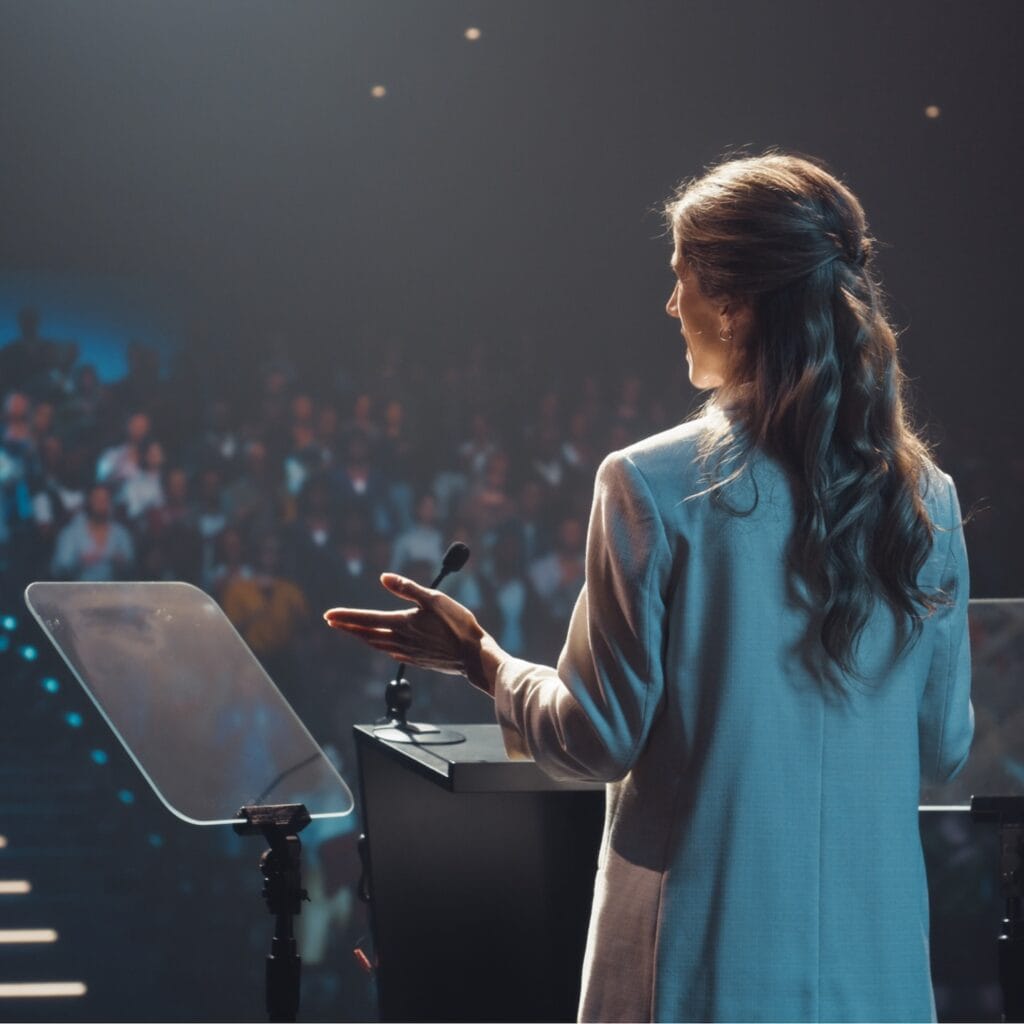
You’ve likely noticed these at political events, corporate conferences, and major speeches: two slim glass panels, like paddles, positioned either side of a lectern at eye level. Despite their location, they remain virtually invisible to the audience.
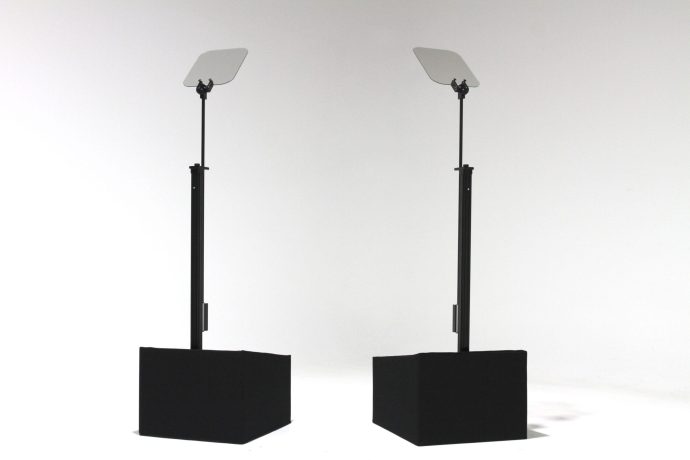
High-brightness monitors at the base of each glass panel project the script upward, reflecting off the angled glass. This creates a display visible only to the speaker, who can glance naturally left and right as they read, while maintaining the appearance of speaking to the entire room in an impromptu way.
Modern systems often include robotic stands that can be adjusted remotely by the operator for different speaker heights, ensuring optimal positioning throughout multi-presenter events, or for clearing camera-shots.
Why Professional Teleprompting Matters
The impact on production quality is immediately apparent when teleprompters are used effectively. Presenters maintain consistent eye contact, eliminating the awkward head movements that occur when reading from notes or cards. Anxiety levels drop significantly when speakers have their safety net of a trusted operator scrolling their text, allowing them to focus on delivery rather than memorisation.
Perhaps most importantly for production schedules, teleprompting dramatically reduces retakes and can keep a production on time. When presenters aren’t struggling to remember their next line or fumbling with physical scripts, the production runs more efficiently. Script changes can be implemented instantly—no need to reprint materials or allow time for memorisation.

The WordBirds Approach
Our wealth of experience supporting productions for television networks in Australia and the UK, along with major corporate clients like Google, Microsoft, and Westpac, has taught us that equipment is only part of the equation. The operator’s skill in matching the presenter’s natural rhythm, formatting script for optimal performance, making real-time adjustments, and troubleshooting technical requirements is key to how well a teleprompter can enhance a performance, and an overall production.
We’ve worked on everything from intimate corporate videos to 24-hour coverage of the Rio Olympics, and large-scale productions like The Voice, Australia. Each production has unique requirements, and our team’s role extends beyond operating equipment to ensuring presenters feel confident and productions run seamlessly.
Making the Right Choice for Your Production
Whether you’re planning a corporate video, live-streaming an AGM, or producing television content, understanding how teleprompters work helps in making informed decisions about your production setup. The technology transforms good presentations into great ones, but success depends on choosing the right equipment configuration and working with experienced operators.
Professional teleprompting isn’t about replacing natural presentation skills—it’s about providing the foundation that allows those skills to shine without the distraction of memory concerns or script management.
Looking for teleprompter solutions for your next production? Our team brings over a decade of industry experience to every project, ensuring your presenters feel confident and your production runs smoothly.